
New AML and Sanctions Rules Are Changing Yacht Operations Across the Industry
Oceaneria Industry Report
By the Oceaneria Recruitment Team
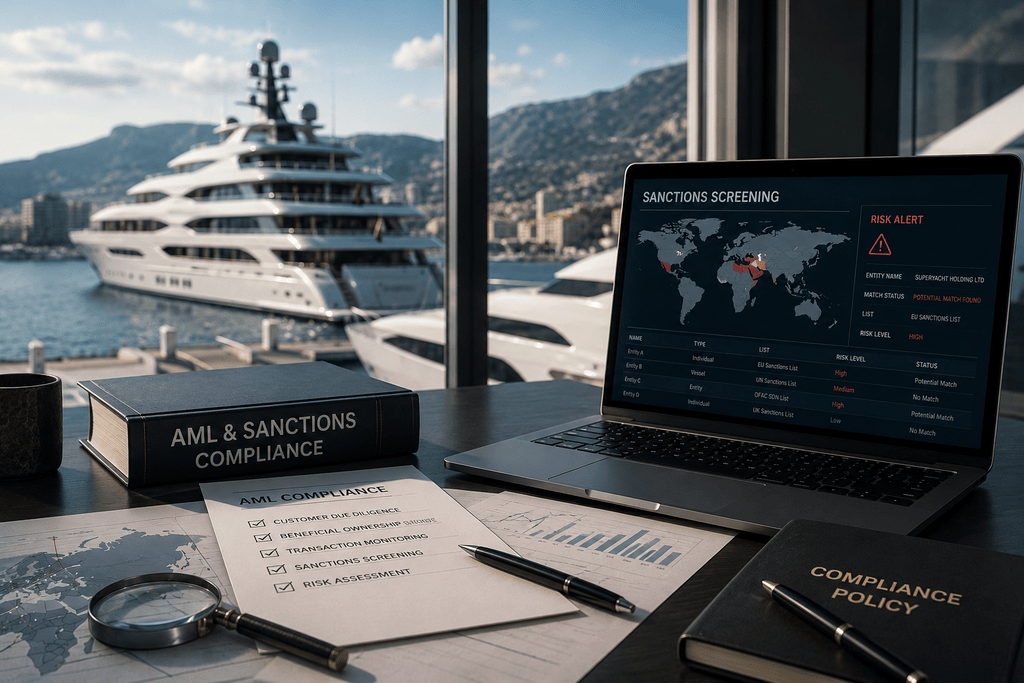
Anti money laundering (AML) regulations and sanctions enforcement are becoming some of the most significant forces shaping the superyacht industry.
What was once largely considered a legal or banking issue is now affecting yacht brokers, captains, managers, family offices, crew agencies, insurers, refit yards, and service providers throughout the sector.
At first glance, compliance may seem like a topic reserved for lawyers and regulators.
However, when we look beyond the headlines, a much bigger shift is taking place.
At Oceaneria, we believe the industry is moving from a model built primarily on relationships and discretion towards one increasingly defined by documentation, verification, and compliance.
The real story is not that regulations are becoming stricter.
The real story is that compliance is becoming part of everyday yacht operations.
Compliance Is No Longer Just A Legal Department Problem
Historically, sanctions and AML requirements were often handled by lawyers, banks, and specialist advisers.
Today, that is changing.
Regulators increasingly expect businesses throughout the maritime ecosystem to understand who they are dealing with, where funds originate, who ultimately controls assets, and whether transactions create sanctions risk.
This means that brokers, managers, captains, suppliers, and service providers can no longer assume compliance is somebody else's responsibility.
At Oceaneria, we see this as one of the most important operational changes affecting the industry.
The question is no longer whether an owner appears on a sanctions list.
The question is whether every party involved can demonstrate they carried out appropriate due diligence.
Europe Is Raising The Compliance Bar
The European Union's new AML framework is creating a more consistent regulatory environment across member states.
The package includes stronger transparency requirements and new controls designed to make financial activity easier to monitor and verify.
While these rules are not aimed exclusively at yachting, the sector naturally falls within the category of high value international transactions that regulators are increasingly focused on.
For yacht businesses operating across multiple jurisdictions, compliance expectations are becoming more standardised and more demanding.
AMLA Signals Stronger Enforcement Ahead
One of the most significant developments is the creation of the European Union's Anti Money Laundering Authority, known as AMLA.
The new authority is intended to improve coordination and enforcement across Europe.
For the superyacht industry, this matters because yacht ownership structures, operations, management companies, and service providers frequently operate across multiple countries.
At Oceaneria, we believe this signals a future where regulators are less willing to tolerate inconsistencies between jurisdictions.
Cross border structures will increasingly face cross border scrutiny.
Brokers Face Greater Responsibility
Yacht brokers are among the groups most affected by the changing landscape.
Industry commentary suggests brokers are moving closer towards formal AML obligations, particularly when handling large transactions and high value clients.
This means stronger onboarding procedures, beneficial ownership checks, sanctions screening, and source of wealth verification.
For many brokerage firms, this represents a significant operational shift.
Relationships still matter, but relationships alone are no longer sufficient.
Increasingly, there needs to be evidence behind the trust.
High Value Transactions Are Receiving Greater Attention
Superyacht sales often involve values far above thresholds that regulators consider high risk.
As a result, yacht transactions are attracting greater scrutiny.
The industry is seeing increased emphasis on documenting ownership structures, transaction flows, funding sources, and beneficial ownership.
At Oceaneria, we believe this reflects a wider trend affecting luxury assets generally.
Yachts are increasingly being viewed through the same compliance lens as private jets, real estate, and other high value investments.
Beneficial Ownership Has Become Critical
One of the most important lessons from recent sanctions cases is that legal ownership and beneficial ownership are not always the same thing.
Authorities increasingly want to know who ultimately controls, benefits from, or influences an asset.
Cases involving vessels such as Dilbar demonstrated how regulators are prepared to look beyond company structures and investigate ultimate ownership relationships.
This represents a major shift for the industry.
Complex ownership structures may remain legal, but they also create compliance challenges if beneficial ownership cannot be clearly demonstrated.
Authorities Are Looking Beyond Paper Ownership
Recent legal cases have shown that regulators are willing to challenge formal ownership arrangements if they believe another individual is the true controlling party.
The Amadea case has become one of the most closely watched examples.
The broader message is clear.
Documentation alone may not be enough.
Authorities are increasingly examining payment flows, operational control, decision making authority, and other indicators of actual ownership.
Routine Services Can Create Compliance Risk
Another major change is that sanctions exposure is no longer limited to yacht purchases.
Routine services can also create risk.
Berthing, maintenance, refits, crew placement, payroll, logistics support, concierge services, and technical assistance may all fall under greater scrutiny if sanctions concerns exist.
This means service providers need a much deeper understanding of the clients and vessels they support.
What may appear to be a routine transaction can carry significant compliance implications.
Captains And Crew Are Being Drawn Into Compliance
Crew members are rarely responsible for ownership structures or financial decisions.
However, they can still be affected by compliance failures.
Sanctioned or detained yachts have demonstrated how operational disruptions can impact wages, rotations, contracts, and vessel operations.
At Oceaneria, we believe this highlights the importance of communication and transparency between owners, managers, and crew.
When compliance issues arise, crew are often among the first people affected operationally.
Yacht Managers Are Becoming Compliance Gatekeepers
Management companies are increasingly expected to act as a first line of defence.
Their responsibilities now extend beyond maintenance schedules, budgeting, and operational oversight.
Managers are being asked to screen suppliers, review transactions, monitor risk indicators, and maintain detailed records.
This is changing the role of yacht management.
Operational management and compliance management are becoming increasingly interconnected.
Family Offices Are Part Of The Compliance Chain
Many yacht ownership structures involve family offices, trustees, advisers, and asset managers.
These organisations often control payments, administration, ownership structures, and financial oversight.
As regulators focus more heavily on beneficial ownership and source of funds, family offices are becoming increasingly important participants in the compliance process.
Their role is no longer purely administrative.
It is also becoming regulatory.
Enhanced Due Diligence Is Becoming Standard
High net worth and ultra high net worth individuals remain the primary customer base for the superyacht industry.
As a result, enhanced due diligence requirements are becoming increasingly common.
Financial institutions and service providers are expected to better understand source of wealth, source of funds, political exposure, and ownership structures.
This does not mean wealthy clients are viewed negatively.
It means regulators consider larger and more complex financial relationships to carry greater inherent risk.
Financial Transparency Is Increasing
New restrictions on cash transactions and growing reporting obligations reflect a wider push towards transparency.
The objective is straightforward.
Regulators want transactions to be traceable.
For yacht transactions, this means greater emphasis on documentation and financial records.
At Oceaneria, we see this as part of a broader trend rather than an isolated regulatory change.
Transparency is becoming a core expectation.
Maritime Compliance Standards Are Expanding
The superyacht industry does not operate in isolation.
It exists within the wider maritime ecosystem.
Ports, insurers, fuel suppliers, classification societies, flag states, banks, and service providers are all increasingly expected to adopt stronger sanctions controls.
As a result, yacht businesses are indirectly affected by compliance standards that extend far beyond the superyacht sector itself.
Vessel Identification Is Becoming More Important
One practical lesson from sanctions enforcement is that vessel names can change.
Ownership structures can change.
Flags can change.
For this reason, compliance professionals increasingly rely on identifiers such as IMO numbers and ownership records rather than vessel names alone.
What appears straightforward on the surface can become significantly more complex under closer examination.
Complex Structures Attract Regulatory Attention
Yachts combine several characteristics regulators view as high risk.
They are valuable assets.
They move internationally.
They often involve multiple jurisdictions.
They are frequently owned through layered structures.
None of these characteristics are inherently problematic.
However, together they create an environment where enhanced due diligence becomes increasingly important.
Sanctions Have Created Real Financial Consequences
The impact of sanctions is not purely theoretical.
Several high profile vessels linked to sanctioned individuals have experienced declining values due to prolonged detention and operational restrictions.
These cases demonstrate that sanctions can create long term consequences for asset value, maintenance, and operations.
The financial impact extends beyond ownership.
It affects the wider ecosystem supporting those vessels.
Maintaining Seized Yachts Is Expensive
Another challenge highlighted by recent cases is the cost of preserving detained assets.
Large yachts remain highly complex technical assets regardless of ownership disputes.
They require maintenance, technical support, crew oversight, and operational management.
The longer enforcement actions continue, the greater the challenge of maintaining vessel condition and value.
Reputation Has Become A Compliance Issue
For yacht businesses, legal exposure is only part of the risk.
Reputational damage can be equally significant.
Brokers, managers, suppliers, crew agencies, and service providers may face scrutiny if they become associated with sanctioned individuals or questionable transactions.
Trust remains one of the industry's most valuable assets.
Protecting that trust increasingly requires strong compliance procedures.
The Industry Is Moving Towards Documented Proof
Looking across all of the developments, one trend stands above the rest.
The superyacht industry is moving from informal trust towards documented proof.
Beneficial ownership checks.
Know Your Customer procedures.
Sanctions screening.
Source of funds verification.
Supplier due diligence.
Transaction monitoring.
Risk assessments.
These practices are becoming standard expectations rather than optional safeguards.
The Oceaneria View
When we look at the growing focus on AML and sanctions compliance, we do not simply see more regulation.
We see a fundamental change in how the superyacht industry operates.
For decades, yachting was built around personal relationships, discretion, and trust.
Those qualities remain important.
However, regulators, banks, insurers, and service providers increasingly want evidence alongside trust.
The industry's future will not be defined by whether compliance requirements continue to grow.
That is already happening.
The more important question is how effectively businesses adapt.
The brokers, managers, family offices, crew agencies, refit yards, and service providers that build strong compliance processes today are likely to become easier to work with, easier to insure, easier to finance, and easier to recommend.
Ultimately, this is not simply a compliance story.
It is a story about professionalism.
And it may prove to be one of the most significant operational shifts the superyacht industry experiences over the next decade.