
Superyacht Industry Generates €54 Billion Annually as Builders Push Back Against the "Luxury Toy" Narrative
Oceaneria Industry Report
By the Oceaneria Recruitment Team
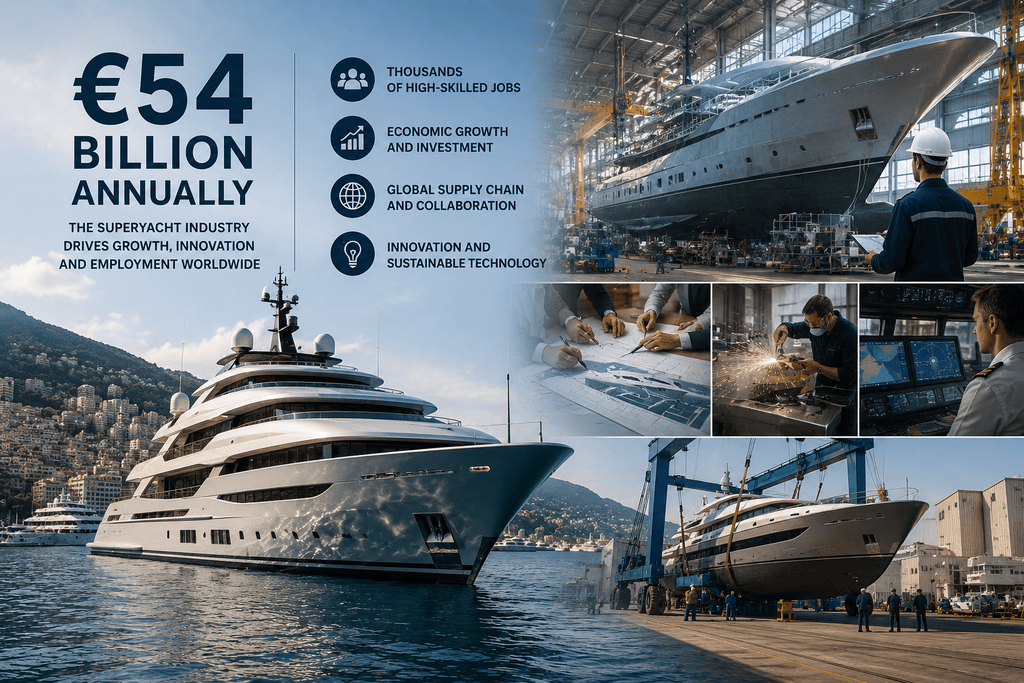
A new industry study has estimated that the global superyacht sector contributes approximately €54 billion to the global economy each year.
At first glance, the figure is impressive.
But the real significance of the report is not the number itself.
At Oceaneria, we believe this study represents a broader effort by the superyacht industry to redefine how it is perceived by governments, regulators, the media, and the public.
For years, superyachts have often been viewed through the lens of wealth, luxury, and excess.
This report tells a different story.
It argues that behind every yacht is a vast network of shipyards, engineers, tradespeople, suppliers, marinas, refit facilities, tourism businesses, and thousands of skilled workers whose livelihoods depend on the sector.
The timing of that message may be just as important as the numbers themselves.
The Study Behind the Headlines
The research was commissioned by the Superyacht Builders Association (SYBAss) and the Superyacht Life Foundation and conducted by Deloitte together with Vrije Universiteit Amsterdam.
According to the findings, the global superyacht sector generated approximately €54 billion in total economic impact during 2022.
Of that figure, approximately €22 billion came from direct expenditure, while a further €32 billion was generated through indirect economic activity across supply chains, operations, tourism, hospitality, and supporting industries.
The report was launched as part of a wider industry initiative designed to better communicate the economic contribution of the sector.
That objective is important because the report appears to be aimed at more than just industry professionals.
It is aimed at policymakers and public opinion.
Why The Industry Is Telling This Story Now
The superyacht industry has found itself under increasing scrutiny in recent years.
Luxury spending, wealth concentration, environmental concerns, and emissions have all become more prominent public discussion points.
As a result, many industry organisations have been looking for ways to explain the wider economic contribution created by superyacht ownership and operation.
From our perspective, this report is part of that effort.
The industry is attempting to shift the conversation away from viewing yachts solely as luxury assets and towards understanding them as economic engines that support thousands of jobs and businesses.
Whether that argument succeeds remains to be seen.
However, it clearly explains why this research is receiving so much attention across the sector.
Builders Sit at the Centre of the Industry
One of the most important findings in the report concerns yacht construction itself.
According to the study, new yacht construction accounts for approximately 37% of the industry's total economic impact, representing around €20 billion globally.
That makes shipyards one of the most important contributors to the entire ecosystem.
This is a point that industry leaders have repeatedly emphasised.
Without designers, naval architects, engineers, welders, electricians, project managers, painters, carpenters, and specialist manufacturers, the wider superyacht economy would not exist.
At Oceaneria, we see this as one of the strongest arguments presented by the report.
While the public often focuses on yacht owners, the industry's economic value is largely created by the thousands of people involved in designing, building, and maintaining the vessels.
The Multiplier Effect Is Larger Than Many Realise
Perhaps one of the most interesting findings is the industry's economic multiplier effect.
The report estimates that every €1 invested in a new yacht generates an additional €1.80 throughout the wider economy.
That creates a total multiplier of 2.8.
This means the financial impact of a new build extends far beyond the shipyard itself.
Materials suppliers, engineering firms, equipment manufacturers, logistics companies, marina operators, hospitality businesses, fuel suppliers, and local service providers all benefit from the activity generated by a single project.
For coastal regions that host major shipyards, the effect can be substantial.
Europe Remains the Centre of Superyacht Production
Although the €54 billion figure represents the global industry, Europe remains at the centre of much of that activity.
Industry estimates suggest that approximately 80% of global superyacht production takes place in Europe.
Countries such as Italy, the Netherlands, and Germany continue to dominate the construction of large custom yachts.
This concentration creates significant economic benefits for local communities and regional supply chains.
The report indirectly reinforces Europe's position as the world's leading hub for high value yacht construction.
Refit Is Becoming Increasingly Important
The report also highlights the growing importance of refit and maintenance activity.
According to the research, refit and maintenance contribute approximately €5.6 billion annually to the global industry.
This figure is likely to become increasingly significant as the global fleet ages.
Many owners are choosing to modernise, upgrade, and extend the life of existing vessels rather than immediately commission new builds.
This creates long term demand for shipyards, engineers, technicians, interior specialists, and service providers.
For many businesses within the industry, refit work has become an essential part of their revenue model.
Every Yacht Supports Ongoing Economic Activity
One statistic that attracted significant attention is the finding that a single superyacht contributes roughly €9 million per year to the wider economy.
This includes crew salaries, maintenance, fuel, marina fees, provisioning, tourism spending, hospitality services, and refit activity.
In other words, the economic impact does not stop when a yacht is delivered.
In many respects, the operational lifecycle of a yacht generates ongoing value for decades.
This is another argument the industry appears keen to emphasise.
Industry Leaders Have Backed the Findings
The report has received strong support from several prominent industry figures.
Dilan Saraç, Executive Director of the Superyacht Life Foundation, highlighted that roughly half of the estimated economic contribution comes from the operation and use of yachts after delivery.
That observation reinforces the importance of crew, service providers, marinas, tourism operators, and support businesses.
Fraser Yachts CEO Anders Kurtén described the figures as robust and suggested that continued charter demand may make the industry's contribution even stronger than the report suggests.
Industry figures including Henk de Vries and Stefano de Vivo also publicly supported the findings, noting that wealth invested in yacht construction creates jobs, industrial knowledge, and economic activity rather than remaining idle in financial markets.
Why The Report Is Being Shared So Widely
One reason this report has gained significant attention across industry publications and social media is that it provides the sector with a clear economic narrative.
Companies including Benetti, Vitters, SuperYacht Times, SYBAss, and numerous industry professionals have shared the findings publicly.
The reason is straightforward.
The report provides measurable data that supports arguments the industry has been making for years.
That superyachts are not simply luxury products.
They are also industrial projects, maritime assets, employment generators, and contributors to regional economies.
Whether critics agree with that position is a separate debate.
But the industry now has data it can point to when making its case.
What This Means for the Future
At Oceaneria, we believe the most important takeaway from this report is not the €54 billion figure itself.
The real story is what the industry is preparing for.
As environmental regulations become stricter and public scrutiny of luxury spending increases, the sector is increasingly focused on demonstrating its wider economic value.
The conversation is shifting.
Instead of discussing yachts purely in terms of ownership and luxury, industry organisations are increasingly talking about employment, manufacturing, skills development, innovation, tourism, and economic contribution.
This report is one of the clearest examples of that shift.
The Oceaneria View
When we look at this study, we do not simply see a €54 billion headline.
We see an industry making the case for its long term relevance.
We see shipbuilders highlighting the thousands of skilled workers behind every yacht.
We see refit yards, suppliers, marinas, and service providers being recognised as essential parts of a much larger ecosystem.
We see an industry responding to growing scrutiny by presenting evidence of its economic contribution.
Most importantly, we see a sector trying to change how the world understands superyachting.
The debate around luxury spending is unlikely to disappear.
Neither are the environmental questions facing the industry.
However, this report demonstrates that the conversation is becoming more nuanced.
The future of the superyacht industry may depend not only on building exceptional yachts, but also on successfully communicating the economic value those yachts create long after they leave the shipyard.