
How Do I Get My First Yacht Job?
Oceaneria Yacht Industry Report
By the Oceaneria Recruitment Team
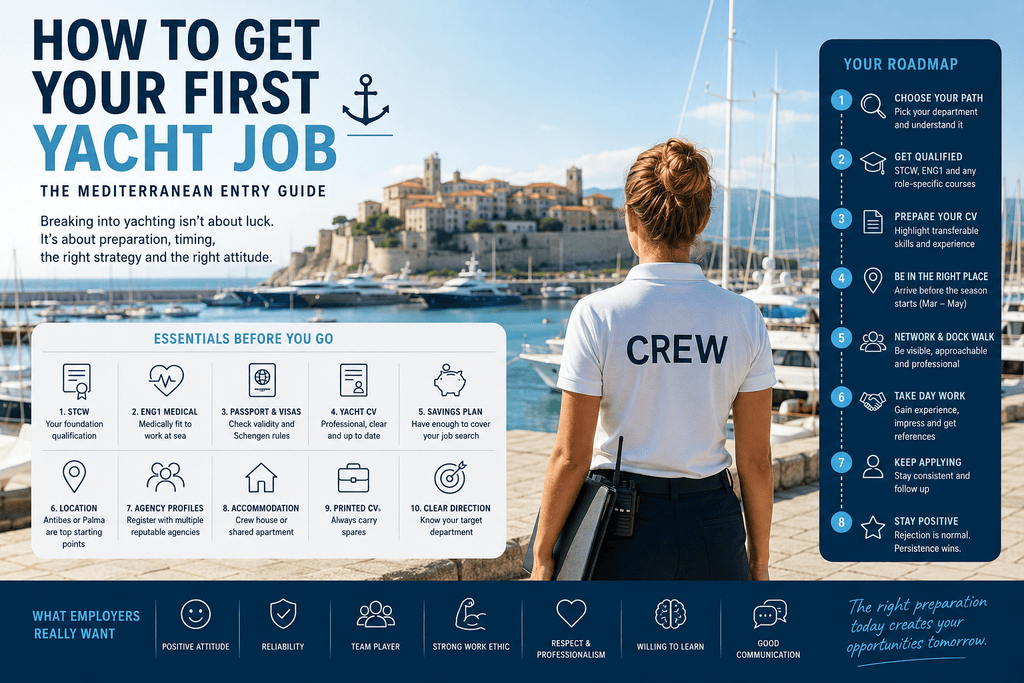
Getting your first yacht job can feel confusing from the outside.
You see the travel, the uniforms, the guest trips, the Mediterranean ports and the lifestyle. Then you start researching and suddenly you’re hit with STCW, ENG1, visas, dock walking, crew houses, agencies, day work, CV photos, references, seasons, Schengen rules and a hundred different opinions.
So let’s slow it down.
Your first yacht job is not usually won by sending one CV and waiting.
It’s normally won through preparation, timing, location, attitude and people.
Especially in the Mediterranean.
First, understand what yachting actually is
Yachting is not a holiday job.
It’s hospitality, safety, maintenance, operations, engineering and service, all packed into a floating workplace.
You live where you work.
You work long days.
You share small spaces.
You follow a chain of command.
You keep smiling even when you’re tired, hot, stressed and cleaning the same thing for the third time.
That’s the reality.
The people who do well are normally the ones who understand this before they arrive. They don’t arrive thinking the yacht is there to give them a lifestyle. They arrive knowing they are there to support the vessel, the guests, the owner and the crew.
That mindset matters.
Decide whether yachting is actually right for you
Before you spend money on courses, flights and accommodation, ask yourself some honest questions.
Can you live in a small cabin?
Can you work seven days a week during busy periods?
Can you take instructions without taking everything personally?
Can you be away from family and friends?
Can you stay professional when you’re tired?
Can you handle hierarchy?
Can you work hard without needing constant praise?
Yachting can be brilliant, but it is not easy.
Some people love the structure, the travel and the intensity.
Others realise very quickly that they don’t want to live at work.
It’s better to know that before you spend thousands trying to get in.
Choose your department before you chase jobs
A common beginner mistake is saying, “I’ll do anything.”
That sounds flexible, but it can also sound unclear.
Yachts hire into departments.
The main onboard departments are:
Deck
Deck crew look after the exterior of the yacht.
This includes washdowns, polishing, lines, fenders, tender work, water toys, anchoring support, guest movements and safety related duties.
A beginner usually starts as a junior deckhand or deckhand.
Good transferable experience includes watersports, sailing, diving, fitness, mechanics, painting, maintenance, military experience and outdoor work.
Interior
Interior crew look after housekeeping, laundry, service and guest areas.
This is where many stewardesses and stewards begin.
Good transferable experience includes hotels, restaurants, bars, private households, housekeeping, events, retail, childcare and high level customer service.
Galley
The galley is the food operation.
Most yacht chefs need proper cooking experience, strong organisation and the ability to work under pressure in a small space.
Entry level galley work may be possible on larger yachts as a crew cook, galley hand or sous chef, but most galley roles expect proven food experience.
Engineering
Engineers keep the yacht running.
This includes engines, generators, hydraulics, watermakers, air conditioning, electrical systems, pumps, AV, IT and general technical problem solving.
Good transferable experience includes mechanical work, marine engineering, electrical work, plumbing, refrigeration, IT, hydraulics and workshop experience.
Bridge and command
This is the navigation and vessel operation side.
Captains and officers do not normally start here without progression, sea time and qualifications. But if your goal is command one day, you need to understand the path early.
Shore based roles
Not every yachting career is onboard.
Shore based careers include yacht management, crew management, recruitment, charter management, brokerage, refit, operations, technical support, marina roles, provisioning and service providers.
If you’re not sure that living onboard is right for you, shore based yachting may still give you a route into the industry.
Match your past experience to the right entry point
Your previous work matters.
Don’t throw it away just because it wasn’t on a yacht.
A restaurant worker may be a strong junior stew candidate.
A hotel housekeeper may understand standards, speed and guest privacy.
A mechanic may be a better engineering candidate than a general deck applicant.
A sailing instructor may have a strong deck profile.
A nanny may fit family yachts.
A personal trainer may suit active charter yachts.
A nurse may suit vessels that value medical confidence.
A carpenter, electrician or plumber may be useful around refit and technical work.
The trick is not to say, “I have no yacht experience.”
The trick is to say, “This is the experience I bring, and this is how it helps onboard.”
Get your mandatory certificates sorted
For most entry level yacht crew, the two big starting points are STCW Basic Safety Training and an ENG1 medical.
These are not nice extras.
They are usually the foundation.
STCW Basic Safety Training teaches the basics of safety at sea. It normally covers fire prevention and firefighting, personal survival, first aid, personal safety and social responsibility.
ENG1 is the medical certificate used to show that you are medically fit to work at sea.
Do these early.
Especially the ENG1.
There is no point paying for everything else if a medical issue stops you from being approved to work onboard.
Don’t collect random courses too early
This is where many newcomers waste money.
They panic and start buying every course they see.
Food hygiene.
Powerboat.
Interior course.
Deck course.
Barista course.
Wine course.
PDSD.
RYA courses.
Some of these can help, but not all are needed for everyone.
Your first question should be, “Which department am I targeting?”
If you want interior, food hygiene and strong service training may help.
If you want deck, tender handling, practical maintenance and watersports experience may help.
If you want engineering, technical tickets and real workshop ability matter more.
Start with the essentials.
Then add courses that support your chosen direction.
Build a proper yacht CV
A yacht CV is not the same as a normal office CV.
It needs to be short, clean and easy to scan.
A captain or recruiter may look at it for only a few seconds.
Your CV should usually include:
✓ Professional headshot
✓ Current location
✓ Availability
✓ Nationality
✓ Passport and visa status
✓ STCW
✓ ENG1
✓ Other certificates
✓ Relevant experience
✓ Languages
✓ References
✓ Clear contact details
Use a professional photo.
Not a party photo.
Not sunglasses.
Not a cropped beach picture.
You’re applying to work in a high trust environment. Your CV should feel clean, calm and credible.
Be honest about your experience
Do not exaggerate.
The yachting industry is small.
If you say you can do silver service and you can’t, someone will find out quickly.
If you say you have tender experience but can’t handle lines properly, that gets noticed.
If you say you did a season when you only did two days of day work, it can damage your reputation.
A green candidate with a good attitude is easier to train than a candidate who pretends to know more than they do.
Be honest, but present yourself well.
Understand the Mediterranean season
For first time crew, the Mediterranean season is one of the main entry routes.
The strongest entry window is normally spring.
Think March, April and May.
That’s when many yachts are preparing for the summer season, coming out of refit, moving into the Med, hiring seasonal crew, picking up day workers and testing new candidates.
By June and July, many roles have already been filled.
There are still jobs, but it gets harder.
If you arrive too late, you may be competing with more people for fewer entry level openings.
Choose your Mediterranean base carefully
The main beginner hubs are still Antibes and Palma.
Antibes
Antibes is one of the best known crew hubs in the South of France.
It works well for candidates targeting motor yachts, especially around the Côte d’Azur.
From Antibes, crew can also look at nearby ports like Cannes, Monaco, Nice, Golfe Juan and Marina Baie des Anges.
La Ciotat can also be useful, especially around refit and yard periods.
Palma de Mallorca
Palma is a major hub in the Balearics.
It has strong activity around motor yachts, sailing yachts, refit, maintenance and seasonal preparation.
It is especially useful for crew who want to be around yachts, agencies, training providers, service companies and other crew.
Other useful Med areas
Depending on the season and your department, you may also look at Barcelona, Genoa, Viareggio, Imperia, San Remo, Monaco, Cannes, Nice and La Ciotat.
Don’t think only in terms of one marina.
Think in terms of movement, timing and opportunity.
Plan your money before you arrive
This is where many people get caught.
Getting your first yacht job can take weeks.
Sometimes longer.
You may need to pay for:
✓ STCW
✓ ENG1
✓ Flights
✓ Accommodation
✓ Food
✓ Local transport
✓ Printing CVs
✓ Laundry
✓ Phone data
✓ Smart clothing
✓ Emergency costs
Crew houses and Mediterranean accommodation can become expensive fast.
If you arrive with barely enough money for a week or two, pressure builds quickly.
And desperation does not help in interviews.
You want enough money to stay calm, keep going and make good decisions.
Understand Schengen before you travel
This is especially important for non EU candidates.
If you are entering the Schengen Area as a short stay visitor, the basic rule is normally 90 days in any 180 day period.
That matters because Antibes, Palma, Barcelona, Genoa, Monaco access routes and many Med hiring areas sit inside or around the Schengen travel zone.
Do not ignore this.
Track your days properly.
Keep proof of travel.
Understand your passport, visa and work status before you arrive.
With the EU Entry Exit System, non EU short stay travellers are now registered digitally when crossing external borders into participating European countries. So relying on old passport stamp confusion is not a plan.
If you are unsure, check official immigration guidance for your nationality before travelling.
Use crew houses as networking tools
A crew house is not just a bed.
It can be part of the job search.
You meet other green crew, experienced crew, people going dock walking, people who have just picked up day work, people who know which marinas are active, and people who hear about last minute opportunities.
That said, crew houses can be costly and basic.
Shared rooms are normal.
Noise is normal.
Competition is normal.
But if you’re arriving alone, a crew house can put you inside the crew network faster than sitting in an apartment by yourself.
Register with yacht recruitment agencies
Do not rely on one agency.
Register with several reputable agencies in your target area.
In the Med, many crew start with agencies in Antibes and Palma.
When you register, make sure your profile is complete.
Upload your CV.
Upload STCW.
Upload ENG1.
Add your location.
Add your availability.
Add your visa status.
Keep your profile updated.
Recruiters work with incomplete information all day. Don’t make them chase you for basics.
Understand how recruiters think
Recruiters are not just trying to find you a job.
They are trying to solve a hiring problem for a captain, management company, owner, chief officer, chief stew or department head.
That means they care about risk.
Will you turn up?
Are your certificates valid?
Are you legal to travel?
Will you fit the crew?
Will you embarrass them if they put you forward?
Will you last?
Will you accept the role and then disappear?
If you understand this, your communication improves.
Be clear.
Be polite.
Reply quickly.
Don’t spam them every hour.
Don’t act entitled.
Make it easy for them to trust you.
Go dock walking properly
Dock walking still gets talked about because it still works in some places, but it has changed.
Security is tighter.
Some marinas restrict access.
Some yachts do not want people walking up uninvited.
Some places are better than others.
But the principle still matters.
You are putting yourself where the work is.
The goal is not to shove a CV at everyone.
The goal is to create a small human connection.
Ask politely if they need day workers.
Ask if you may leave your CV.
Keep it short.
Respect the crew’s time.
Dress properly.
Carry water.
Have your phone charged.
Bring printed CVs.
Start early, often around the time crew are moving before the day gets too busy.
If someone says no, thank them and move on.
Do not argue.
Do not push.
Do not look annoyed.
That person may remember you later.
Treat day work as your first interview
Day work is one of the most important entry routes.
It gives you experience, contacts, confidence and references.
It may also lead to a permanent role.
When you get day work, treat it seriously.
Arrive early.
Bring what you were asked to bring.
Listen carefully.
Don’t pretend you know things.
Ask sensible questions.
Stay off your phone.
Work cleanly.
Move with purpose.
Be positive.
At the end, ask if they would be comfortable acting as a reference if the work went well.
Also take contact details.
A day of work is not just a day of money.
It’s a relationship.
Build references as soon as possible
Your first reference matters.
Then your second.
Then your third.
Yachting runs on trust.
A captain is much more likely to consider you if another captain, chief officer, bosun, chief stew or engineer says, “Yes, they worked well.”
Keep a simple record of every day work job.
Yacht name.
Date.
Contact person.
Role.
Tasks completed.
Phone number or email.
Notes.
You will forget details later if you don’t write them down.
Network without being annoying
Networking is not walking around asking everyone for a job.
It’s building familiarity.
Speak to people in crew houses.
Attend agency events if they are relevant.
Be friendly at training centres.
Join local crew groups.
Follow up politely.
Help other people when you can.
Share useful information.
Don’t be the person who only appears when they need something.
The Med yacht world is smaller than it looks.
Your name travels.
Good and bad.
Clean up your social media
Assume people may look you up.
Because they might.
Remove anything that makes you look risky.
Too much partying.
Aggressive comments.
Offensive jokes.
Public drama.
Unprofessional photos.
Yachts are private, high trust workplaces.
Owners, guests and families expect discretion.
Your online profile should not make someone question your judgement.
Prepare for interviews before they happen
First yacht interviews can happen quickly.
Sometimes you get a call and need to be ready that day.
Prepare answers for:
Why do you want to work in yachting?
Why this department?
What relevant experience do you have?
Can you handle long hours?
Are you happy sharing a cabin?
What are your long term plans?
When are you available?
Where are you located?
Are your certificates valid?
Can you travel?
Keep your answers simple and honest.
Don’t say, “I love travel” as your main answer.
Everyone loves travel.
Talk about work ethic, service, learning, standards, teamwork and why the role suits your background.
Know what employers really want from green crew
Most entry level candidates think the job is won by certificates.
Certificates get you through the door.
Attitude often gets you hired.
Employers want someone who is:
✓ Reliable
✓ Presentable
✓ Calm
✓ Willing to learn
✓ Hard working
✓ Honest
✓ Respectful
✓ Good with people
✓ Able to take feedback
✓ Not full of drama
On your first job, you are unlikely to be the most skilled person onboard.
That’s fine.
But you can be the person who turns up early, listens, works hard and doesn’t complain.
That alone can separate you from half the crowd.
Learn basic yacht etiquette early
Small things matter onboard.
Respect hierarchy.
Don’t walk into guest areas unless told.
Don’t touch things you don’t understand.
Don’t gossip about owners, guests or crew.
Don’t post yacht details online without permission.
Keep your cabin tidy.
Be careful with radios.
Use names and titles correctly.
Say thank you.
Clean as you go.
When in doubt, ask.
Good etiquette makes you easier to live with.
And in yachting, being easy to live with matters.
Keep applying online, but don’t hide behind the laptop
Online applications matter.
Agency profiles matter.
Job boards matter.
But for green crew in the Med, sitting in a room applying online all day is usually not enough.
You need a mixed approach.
Apply online.
Register with agencies.
Dock walk where allowed.
Look for day work.
Network.
Visit crew hubs.
Stay visible.
Follow up.
Improve your CV.
Keep moving.
Your first job is often the result of several small actions stacking together.
Be ready for rejection
You will hear no.
A lot.
You may be ignored.
You may apply and never hear back.
You may be told you need experience.
You may watch someone else get the role.
This is normal.
It does not mean you are finished.
It means you are entering a competitive industry.
The people who get through usually keep improving.
They change their CV.
They practise interviews.
They ask for feedback.
They build contacts.
They take day work.
They stay professional.
They keep going.
Think beyond the first job
Your first yacht job matters, but it is not the whole career.
The first role is about getting in, learning, proving yourself and building references.
Once you have your first proper experience, the next role becomes easier.
Then you can start thinking about progression.
Deckhand to lead deckhand.
Lead deckhand to bosun.
Bosun to officer.
Junior stew to second stew.
Second stew to chief stew.
Junior engineer to engineer.
Crew cook to yacht chef.
Or onboard crew to shore based yacht management, recruitment, operations, charter, brokerage or refit.
Don’t just chase any job.
Build a path.
A practical first yacht job roadmap
Here is the simple version.
Step one, decide if yachting is right for you.
Step two, choose your department.
Step three, map your transferable experience.
Step four, complete your ENG1 and STCW.
Step five, prepare a proper yacht CV.
Step six, check your passport, visa and Schengen situation.
Step seven, save enough money for the job search period.
Step eight, choose your Med base, usually Antibes or Palma.
Step nine, arrive before or during the spring hiring window.
Step ten, register with multiple agencies.
Step eleven, stay in or near the crew network.
Step twelve, dock walk where allowed.
Step thirteen, chase day work professionally.
Step fourteen, collect references.
Step fifteen, keep applying, networking and improving.
Step sixteen, treat every interaction like it could lead somewhere.
Because in yachting, it often can.
Final thought
Getting your first yacht job is not about luck alone.
Luck helps, of course.
But most “lucky” crew were already prepared.
They had the certificates.
They had the CV.
They were in the right place.
They spoke to people.
They took day work.
They followed up.
They stayed professional.
They kept showing up.
That is how many first yacht jobs happen.
Not all at once.
Not from one perfect application.
But from doing the right small things, every day, until someone finally says, “Can you start tomorrow?”
Join Our Yacht Professional Network
If you're ready for your next opportunity, up for the challenge of building a career in the yachting industry, or simply want to stay informed about future roles, salary insights and industry opportunities, we encourage you to submit your profile to Oceaneria.
By joining our network, you'll become part of a growing community of yacht professionals and gain access to career opportunities, industry knowledge and practical insights designed to help you move forward.

