
Rotation vs Permanent Positions in Yachting
Oceaneria Yacht Industry Report
By the Oceaneria Recruitment Team
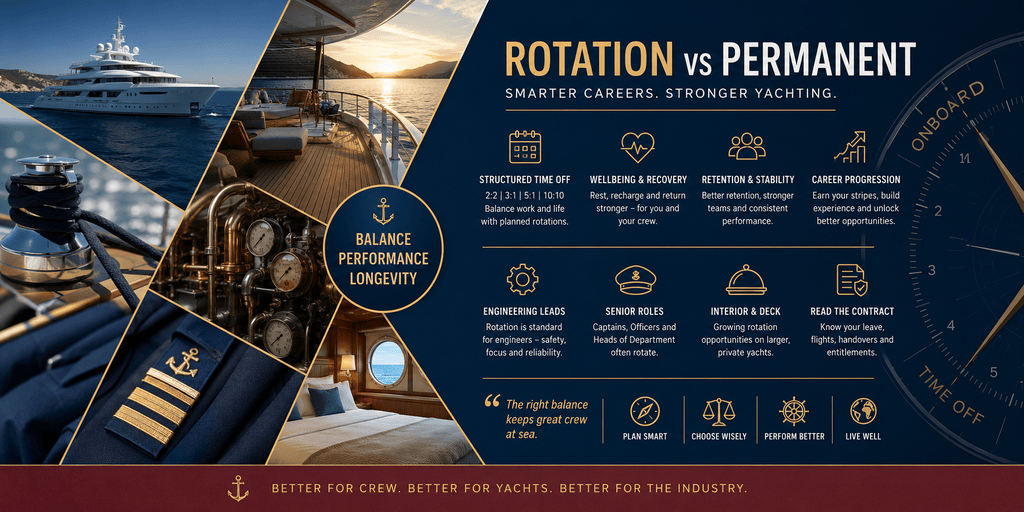
Rotation is one of the biggest career topics in yachting.
Some crew see it as the goal.
Some yachts see it as a cost problem.
Some senior crew see it as the only way to stay in the industry long term.
And for new crew, it can be a little awkward, because asking for rotation too early can be badly received.
Not always.
But often.
So let’s unpack it properly.
What does rotation mean?
A rotational position means two or more people share the same job on a planned schedule.
One person is onboard.
The other person is off.
Then they swap.
Common rotation patterns include:
✓ 2:2 means 2 months onboard, 2 months off
✓ 3:1 means 3 months onboard, 1 month off
✓ 10:10 means 10 weeks onboard, 10 weeks off
✓ 8:8 means 8 weeks onboard, 8 weeks off
✓ 5:1 means 5 months onboard, 1 month off
The cleaner the rotation, the easier it is to understand.
A 2:2 is simple. You work two months, then you go home for two months.
A 3:1 gives you less time off, but still gives you planned recovery.
A 5:1 is better than no structure, but it is still a long time onboard.
What does permanent mean?
A permanent yacht position means the role continues until the contract ends, the yacht gives notice, or the crew member leaves.
It does not mean you never get leave.
That’s a common misunderstanding.
Permanent crew should still have leave entitlement written into their contract.
The difference is that leave may not follow a fixed rotation pattern. You may get leave when the yacht’s programme allows it.
That can work well on a well run yacht.
It can also become frustrating if leave keeps being delayed, moved or made unclear.
Leave and rotation are not the same thing
This is important.
A job advert may say:
“90 days leave.”
That is not always the same as:
“3:1 rotation.”
A true rotation means the yacht has built your off time into the crewing model.
There is someone to cover your role.
The swap is expected.
The dates are normally planned.
A leave allowance means you are entitled to leave, but the timing may depend on the yacht.
So before accepting a role, ask:
✓ Is this a fixed rotation?
✓ Who covers me when I am off?
✓ Are flights paid?
✓ Is leave paid?
✓ Is travel time counted as leave?
✓ Is this written into the contract?
✓ What happens if the season changes?
If it is not written down, be careful.
Why rotation has become such a big topic
Yachting is intense.
Crew live and work in the same space.
During busy Med periods, days can be long. Guest trips, charter turnarounds, owner trips, laundry, washdowns, late service, engineering issues and tender operations all stack up.
People can love the job and still get tired.
Rotation gives crew a way to recover properly.
It lets people see family, maintain relationships, study, train, rest, handle personal admin and come back with a clearer head.
That matters.
Because tired crew do not stay forever.
Is rotation worth it?
For many experienced crew, yes.
Rotation can be worth it because it gives you a life outside the yacht.
That is the blunt answer.
It can help you stay in yachting longer.
It can reduce burnout.
It can give you more predictable time with family.
It can make training easier.
It can help you come back sharper.
But it is not automatically the best option for every person at every stage.
For someone new, a permanent or seasonal role can sometimes be better because you need experience, references and time onboard.
For a senior engineer, captain, chief stew or officer, rotation may be essential.
For a green deckhand or junior stew, rotation may be nice, but not always realistic.
The “earn your stripes” problem
This is one of the most honest parts of the conversation.
New crew sometimes enter the industry and immediately ask for rotation.
In some cases, that can work.
But often, it is not well received.
Why?
Because rotation is usually seen as something linked to trust, experience and value.
If you are new, the yacht is already taking a chance on you.
You still need to learn the work.
You still need to prove your attitude.
You still need to show that you can live onboard.
You still need to build references.
So when a new candidate asks for rotation from the start, some captains and senior crew may hear:
“I want the benefit before I have proved the value.”
That may sound harsh, but it is how parts of the industry still think.
The better approach is usually:
Get in.
Work hard.
Build references.
Stay professional.
Learn the job.
Then aim for rotation as your career develops.
Why engineers often get rotation first
Engineering is the department where rotation is most common.
That’s partly because many engineers come from commercial maritime backgrounds, where rotation is normal.
It is also because engineering fatigue can create real risk.
If an engineer is exhausted, technical mistakes can become serious quickly.
Common rotational engineering roles include:
✓ Chief Engineer
✓ Second Engineer
✓ Sole Engineer on larger programmes
✓ ETO
✓ AV/IT Engineer
✓ Refit Engineer
✓ Temporary Relief Engineer
In the Mediterranean, rotational engineering roles are common on larger private yachts, dual season yachts, yachts with heavy technical programmes, and yachts moving between Med season, yard periods and winter operations.
Captain and officer rotation
Rotation is also common for captains and senior officers on larger yachts.
These roles carry high responsibility.
Navigation, crew management, safety, owner relations, charter pressure, compliance and operational planning all sit close to the bridge team.
Common rotational bridge and deck leadership roles include:
✓ Captain
✓ Relief Captain
✓ Chief Officer
✓ Second Officer
✓ OOW
✓ Bosun on larger yachts
✓ Lead Deckhand on larger yachts
On smaller Mediterranean yachts, captains are often permanent with agreed leave rather than fully rotational.
On larger yachts, especially those operating year round, rotation becomes more common.
Interior rotation is growing, but it is competitive
Interior crew are asking for rotation more often.
That makes sense.
Interior work can be physically and emotionally demanding.
Laundry does not stop.
Housekeeping standards are high.
Guest service can run late.
Cabin resets can be intense.
The work is also very personal, because interior crew are often closest to the guest experience.
Common rotational interior roles include:
✓ Chief Stewardess
✓ Second Stewardess
✓ Lead Service Stewardess
✓ Lead Housekeeping Stewardess
✓ Service Stewardess
✓ Housekeeping Stewardess
✓ Spa Therapist
✓ Nurse Stewardess
✓ Hairdresser Stewardess
The stronger rotation options tend to sit on larger yachts with bigger departments.
On smaller yachts, there may simply not be enough crew, cabin space or budget to rotate interior roles properly.
Junior interior crew and rotation
Junior stews can get rotation, but it is not always the norm.
A junior stew is still learning.
They need repetition.
They need a full season.
They need to understand guest service, housekeeping, laundry, crew mess routines, provisioning support, table setup, cabins, detailing and how the department works under pressure.
A heavy rotation too early can slow that learning.
This is why a permanent first role can sometimes be better.
Not because rotation is bad.
But because experience matters.
One strong full season on a good yacht can do more for a junior career than chasing a rotational role that is hard to get and does not build enough depth.
Deck rotation usually comes with experience
Deckhands often want rotation too.
But for green deck crew, it is less common.
Deck work requires practical skill, safety awareness, line handling, tender work, maintenance, washdowns, guest awareness, anchoring support, toys, exterior detailing and sometimes night watches.
You need time to build confidence.
As deck crew move up, rotation becomes more realistic.
Common rotational deck roles include:
✓ Bosun
✓ Lead Deckhand
✓ Experienced Deckhand
✓ Tender Driver
✓ Watersports Specialist
✓ Chase Boat Captain
✓ Officer roles
For Mediterranean yachts, rotational deck roles are more likely on larger yachts, busy private yachts, dual season programmes and vessels that need stable senior deck support.
Galley rotation depends on yacht size
Chefs can be rotational, but it depends heavily on the yacht.
On smaller yachts, one chef may carry the full season.
On larger yachts, there may be a head chef, sous chef, crew chef and temp cover.
Common rotational galley roles include:
✓ Head Chef
✓ Sous Chef
✓ Crew Chef
✓ Sole Chef on larger private programmes
✓ Relief Chef
✓ Temporary Charter Chef
The galley is high pressure during Mediterranean summer.
Private yachts may be more likely to offer structured rotation.
Charter yachts may need strong continuity during the season, especially if guests expect a consistent food style.
Private yachts versus charter yachts
Private yachts are often better rotation targets.
Especially larger private yachts.
They may have bigger budgets, larger teams and more predictable owner use.
Charter yachts can be different.
The Med charter season can be intense, and the yacht may want the same team in place through the busiest months.
There is also tip income to consider.
Some crew prefer busy charter yachts because the earning opportunity can be strong.
Others prefer private rotational yachts because balance and recovery matter more.
Neither is automatically better.
It depends on the crew member, the yacht and the career stage.
Smaller yachts struggle with rotation
Rotation sounds simple until you look at the maths.
On a 35m yacht, one person may cover a large amount of responsibility.
If that person goes off, the yacht needs cover.
That means more salary, more flights, more crew admin and possibly more cabin pressure.
Smaller yachts may not have the room or budget.
That is why many smaller Mediterranean yachts still use permanent or seasonal contracts with leave, rather than full rotation.
Larger yachts can support rotation better
Larger yachts can often manage rotation more easily.
They have bigger departments.
They have more crew cabins.
They have more structured systems.
They may operate year round.
They may need better retention because replacing senior crew is costly and disruptive.
Rotation is especially common on larger yachts for:
✓ Engineers
✓ Captains
✓ Officers
✓ Chief Stews
✓ Senior Interior
✓ ETO and AV/IT
✓ Specialist roles
✓ Some deck and galley roles
This is why candidates looking for rotation often aim at larger vessels.
The Mediterranean angle
The Mediterranean has its own rhythm.
Spring is preparation.
Summer is pressure.
Autumn is changeover, yard planning, crossings or winter setup.
Winter may mean refit, maintenance, shipyard work or a move to another season.
In places like Antibes, Monaco, Cannes, Nice, Palma, Barcelona, Genoa, Viareggio and La Ciotat, rotation depends on the yacht’s programme.
A yacht doing a full Med season may not want major crew disruption during peak summer.
A large private yacht based around the Med may plan rotation more cleanly.
A dual season yacht moving between the Med and Caribbean may have a more structured crew model.
A yard period may create opportunities for relief crew, engineers, temp chefs and short term cover.
So in the Med, rotation is not just about the role.
It is about the programme.
What crew like about rotation
Crew usually like rotation because it gives them breathing space.
The biggest benefits are:
✓ Proper recovery
✓ Time with family
✓ Better relationships
✓ More predictable life planning
✓ Time to study
✓ Time to renew documents
✓ Less burnout
✓ Clearer boundaries
✓ Better mental health
✓ Longer career life
There is a simple human side to this.
People can work extremely hard when they know they have proper time off coming.
What crew dislike about rotation
Rotation is not perfect.
Common frustrations include:
✓ It can be hard to get
✓ It may pay less than some busy roles
✓ Leave can be moved if the yacht is badly organised
✓ Handovers can be poor
✓ Rotation partners may have different standards
✓ Some yachts still contact crew during leave
✓ Travel can be tiring
✓ Some adverts are unclear
✓ Junior crew may get fewer learning days onboard
The biggest problem is unclear wording.
If the yacht says “rotation”, the candidate needs to know exactly what that means.
What employers like about rotation
Employers and captains may like rotation because it helps keep good people.
A rested crew member is usually better than an exhausted one.
Rotation can help with:
✓ Retention
✓ Morale
✓ Safety
✓ Consistency
✓ Lower turnover
✓ Better long term standards
✓ Less constant retraining
✓ More mature career crew
If a yacht loses good crew every season, rotation may be cheaper than it looks.
Recruitment, training and disruption all cost money too.
What employers dislike about rotation
The downside for yachts is cost and complexity.
Rotation can mean:
✓ More salary cost
✓ More flights
✓ More insurance
✓ More uniforms
✓ More admin
✓ More handover time
✓ More planning
✓ More risk of inconsistency
Two people sharing one role can work brilliantly.
But only if the yacht manages it properly.
If not, it can become messy.
Rotation needs strong handover
A bad handover can make rotation fail.
The yacht needs systems.
Not vague chats.
Proper systems.
Good rotation needs:
✓ Written handover notes
✓ Maintenance logs
✓ Inventory records
✓ Guest preference notes
✓ Department checklists
✓ Clear task ownership
✓ Standard operating procedures
✓ Arrival and departure overlap where possible
✓ Honest communication between rotation partners
Without this, people miss things.
Then blame starts.
And once blame starts, the rotation becomes stressful.
The “pride of place” issue
There is another subtle problem.
When two people share one job, one person may feel less ownership.
You may hear things like:
“That happened while they were onboard.”
“They didn’t leave it properly.”
“I always come back to a mess.”
“They don’t do it my way.”
That can damage the department.
Good leadership prevents this.
The role must belong to the yacht, not to one person’s ego.
The standard must be shared.
The handover must be clear.
The goal must be the same.
Permanent positions still matter
Permanent roles are not bad.
In fact, many crew build excellent careers through permanent roles.
A good permanent role can offer:
✓ More time to learn
✓ Better continuity
✓ Stronger relationships onboard
✓ More ownership
✓ More exposure to the full season
✓ Better references
✓ Faster skill building
For new crew, this can be extremely valuable.
A first job is not always about getting the perfect package.
Sometimes it is about getting the right experience.
When permanent becomes a problem
Permanent becomes a problem when leave is unclear, rest is poor, leadership is weak or the yacht runs people into the ground.
If crew never know when they can go home, resentment builds.
If leave keeps getting delayed, trust drops.
If crew are always tired, standards drop.
If the yacht ignores fatigue, safety can suffer.
A permanent position on a good yacht can be excellent.
A permanent position on a badly run yacht can push people out of the industry.
The best role depends on your career stage
For green crew:
A permanent or seasonal role may be the best first step.
For experienced crew:
Rotation becomes more realistic and more valuable.
For senior crew:
Rotation may be necessary for long term career health.
For engineers:
Rotation is often a normal expectation.
For captains and officers:
Rotation can protect decision making and reduce fatigue.
For interior:
Rotation is growing, especially on larger yachts, but competition is strong.
For deck:
Rotation usually improves as you gain experience and move into senior roles.
Questions crew should ask before accepting rotation
Before accepting a rotational role, ask:
✓ What is the exact rotation pattern?
✓ Is it written into the SEA or contract?
✓ Is leave paid?
✓ Are flights covered?
✓ Who pays for repatriation?
✓ Is there a rotation partner?
✓ Is there handover time?
✓ What happens during charter season?
✓ Can leave be moved?
✓ Does leave accrue during probation?
✓ What happens if the yacht changes programme?
Do not be embarrassed to ask.
These are normal professional questions.
Questions employers should ask before offering rotation
Yachts should also be honest.
Before offering rotation, they should ask:
✓ Can we afford it properly?
✓ Do we have enough cabin space?
✓ Can we manage handovers?
✓ Do we have written procedures?
✓ Is this role senior enough to justify rotation?
✓ Will rotation improve retention?
✓ Will the crew member still get enough time to learn?
✓ Can the yacht operate smoothly during swaps?
Rotation should not be used as a vague selling point.
It must be operationally real.
Rotation as a retention tool
The strongest argument for rotation is retention.
Good crew are hard to find.
Good senior crew are even harder to replace.
If rotation helps keep them for three years instead of one, that matters.
The yacht keeps knowledge.
The owner gets consistency.
The department stays stable.
Recruitment pressure drops.
New crew get better leadership.
That is where rotation starts making sense as a business decision, not just a crew benefit.
Rotation as a safety tool
Rotation also has a safety side.
This is especially important for captains, officers and engineers.
Fatigue affects judgement.
Judgement affects safety.
A rested bridge team and a rested engineering team are not just happier.
They are safer.
That is why rotation is not only about lifestyle at senior and technical levels.
It is part of responsible vessel operation.
Is rotation the future?
Rotation is clearly becoming more important.
Crew are asking for it.
Senior crew expect it.
Engineers often require it.
Large yachts are using it to retain people.
But it will not replace every permanent role.
Smaller yachts, seasonal yachts and some charter yachts will continue using permanent or seasonal contracts.
The future is probably not “rotation for everyone.”
It is more likely:
Better rotation for senior and technical roles.
More structured leave for permanent crew.
More honest job adverts.
Better contracts.
Better handovers.
Better planning.
And more realistic expectations from candidates.
Oceaneria view
Rotation is one of the clearest signs that yachting is becoming more professional.
Crew are no longer just asking, “What is the salary?”
They are asking:
Can I survive this job long term?
Can I have a life?
Can I recover properly?
Can I build a career without burning out?
That is a good thing.
But rotation also needs maturity.
For new crew, asking for rotation before proving yourself can work against you.
Not because wanting balance is wrong.
It is not wrong.
But because yachting still values trust, time served, references and proven attitude.
You usually need to earn your place before you can negotiate the better package.
For experienced crew, rotation can be the difference between staying in the industry and walking away.
For yachts, rotation can feel expensive, but losing good people is expensive too.
The real question is not whether rotation is good or bad.
The real question is whether the package fits the role, the yacht, the programme and the person.
A vague rotation on a badly run yacht is not a dream job.
A clear permanent role on a good yacht can be a smart career move.
But a proper rotational role on a strong yacht, with clear terms and good leadership, can be one of the best ways to build a long career in yachting.
Final thought
If you are new, do not make rotation your only goal.
Make competence your first goal.
Get experience.
Build references.
Learn how yachts work.
Show that you are reliable.
Then rotation becomes a much stronger conversation.
If you are experienced, be clear about what you need.
Ask proper questions.
Read the contract.
Protect your leave.
And choose the yacht, not just the schedule.
Because in yachting, the best package is not always the one that sounds best on paper.
It is the one that actually works in real life.

