
Understanding Yacht Fundamentals
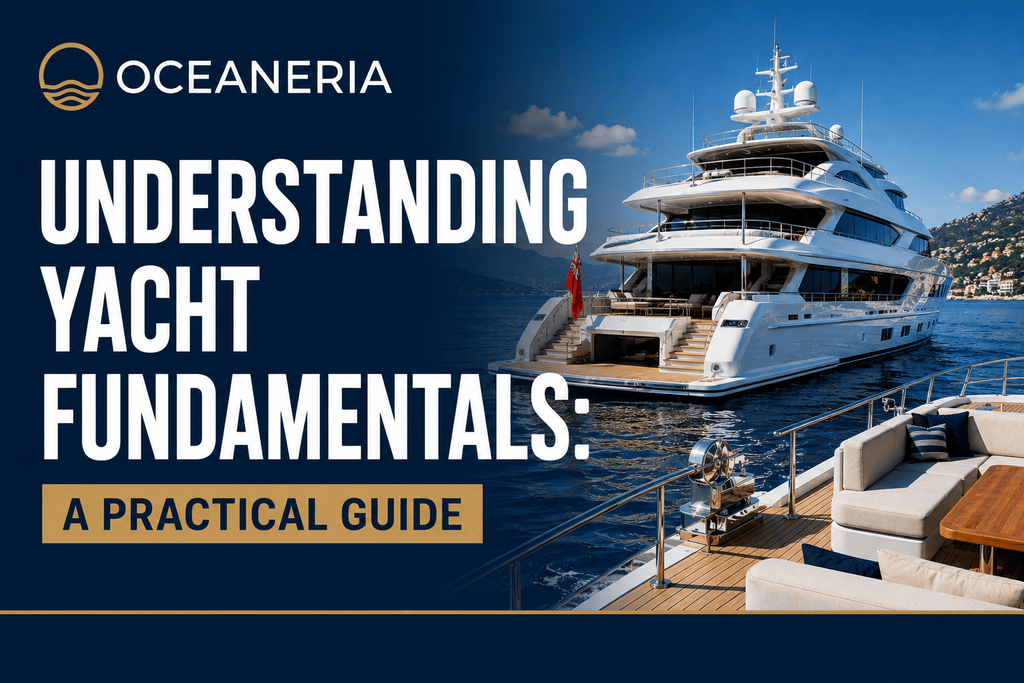
A Practical Guide to Understanding Yachts
Introduction
If you're new to yachting, the industry can feel overwhelming.
People talk about bows, beams, draught, gross tonnage, bridge decks, bosuns, charter operations, flag states, and classification societies as if everyone already knows what they mean.
The reality is that most people don't.
Whether you're considering a career in yachting, hiring crew, supporting the industry, or simply wanting to understand how yachts work, the first step is learning the fundamentals.
This guide has been designed to help you understand the basic structure of a yacht, the people who operate it, and the industry that surrounds it.
Let's begin with the vessel itself.
Understanding The Yacht
Imagine you are standing in the middle of a yacht.
The easiest way to understand yacht terminology is to picture yourself physically on board.
What Is The Bow?
The bow is the front of the yacht.
When the yacht moves through the water, the bow is the first part of the vessel to meet the waves.
The shape of the bow plays a major role in comfort, efficiency, and performance.
Some bows are designed to improve fuel efficiency, while others are designed to improve comfort in rough seas.
Quick Check
1. What is the bow?
A) The rear of the yacht
B) The front of the yacht
C) The widest part of the yacht
D) The highest deck
2. Which part of the yacht meets the waves first?
A) Stern
B) Beam
C) Bow
D) Hull
3. Why is bow design important?
A) It determines the paint colour
B) It affects comfort and performance
C) It determines the crew size
D) It controls the navigation system
Answers
B
C
B
What Is The Stern?
The stern is the rear of the yacht.
Many yachts have swim platforms, beach clubs, and tender access areas located at the stern.
When someone says "meet me at the stern", they mean the rear of the vessel.
Quick Check
1. What is the stern?
A) Front
B) Centre
C) Rear
D) Bridge
2. Which area is often located at the stern?
A) Anchor equipment
B) Swim platform
C) Radar mast
D) Wheelhouse
3. The stern is located opposite the:
A) Beam
B) Hull
C) Bow
D) Bridge
Answers
C
B
C
Port And Starboard
When facing the bow:
Port is the left side.
Starboard is the right side.
These terms never change.
Even if you turn around, the yacht's port side remains the port side.
A useful memory aid is that "port" and "left" both contain four letters.
Quick Check
1. Port is which side of the yacht?
A) Right
B) Left
C) Front
D) Rear
2. Starboard is which side of the yacht?
A) Left
B) Front
C) Right
D) Rear
3. Why are port and starboard used?
A) They are easier to say
B) They provide fixed directions
C) They are legal requirements
D) They identify ownership
Answers
B
C
B
Understanding Yacht Measurements
When discussing yachts, three measurements appear constantly.
Length
Length Overall (LOA) is the total length of the yacht from the furthest point at the bow to the furthest point at the stern.
Beam
The beam is the widest point of the yacht.
A wider beam generally means more internal space and greater stability.
Draught
Draught is the depth of the yacht below the waterline.
A yacht with a deeper draught requires deeper water.
Quick Check
1. What does LOA measure?
A) Height
B) Width
C) Total length
D) Weight
2. What is the beam?
A) Highest point
B) Deepest point
C) Widest point
D) Longest point
3. What does draught measure?
A) Fuel capacity
B) Depth below the waterline
C) Weight
D) Speed
Answers
C
C
B
Understanding Hulls
The hull is the main body of the yacht that sits in the water.
Everything else is built on top of it.
The hull affects stability, speed, comfort, fuel consumption, and interior volume.
Monohull
A monohull has a single hull.
Most superyachts use monohull designs.
Catamaran
A catamaran has two hulls.
Catamarans often provide greater stability and more usable deck space.
Trimaran
A trimaran has three hulls.
These are less common but can offer excellent performance and stability.
Quick Check
1. How many hulls does a monohull have?
A) One
B) Two
C) Three
D) Four
2. How many hulls does a catamaran have?
A) One
B) Two
C) Three
D) Four
3. What is the hull?
A) Navigation equipment
B) Main body of the yacht
C) Crew area
D) Engine room
Answers
A
B
B
Understanding Yacht Decks
Yachts are often divided into multiple levels known as decks.
As yachts become larger, additional decks are added.
Lower Deck
Often contains guest cabins, crew cabins, and technical spaces.
Main Deck
Usually contains the main guest areas and saloons.
Upper Deck
Found on larger yachts and provides additional guest spaces.
Bridge Deck
Contains the wheelhouse and navigation areas.
Sun Deck
An outdoor deck used for relaxation, dining, and entertainment.
Quick Check
1. Which deck often contains guest cabins?
A) Sun Deck
B) Lower Deck
C) Bridge Deck
D) Mast Deck
2. Where is the wheelhouse usually located?
A) Lower Deck
B) Main Deck
C) Bridge Deck
D) Beach Club
3. Which deck is primarily used for outdoor relaxation?
A) Lower Deck
B) Engine Deck
C) Sun Deck
D) Tank Deck
Answers
B
C
C
Understanding Crew & Departments
A yacht is operated by people.
Each department has a specific role.
Bridge Department
Responsible for navigation and overall vessel operations.
Typically led by the captain.
Deck Department
Responsible for exterior maintenance, mooring, anchoring, tenders, and watersports equipment.
Engineering Department
Responsible for machinery, propulsion systems, electrical systems, and technical operations.
Interior Department
Responsible for guest service, housekeeping, laundry, and hospitality.
Galley Department
Responsible for food preparation and catering.
Quick Check
1. Which department is responsible for navigation?
A) Interior
B) Galley
C) Bridge
D) Deck
2. Which department maintains the exterior of the yacht?
A) Engineering
B) Deck
C) Galley
D) Interior
3. Which department looks after guests?
A) Interior
B) Bridge
C) Engineering
D) Deck
Answers
C
B
A
Understanding Yacht Operations
Yachts perform a variety of activities during normal operations.
These activities are carried out by the crew.
Examples include:
Anchoring
Mooring
Refuelling
Guest transfers
Tender operations
Charter operations
Watchkeeping
Every yacht operation involves teamwork between multiple departments.
Quick Check
1. What is anchoring?
A) Connecting to shore power
B) Securing the yacht using an anchor
C) Refuelling
D) Cleaning the hull
2. What is a tender?
A) A crew cabin
B) A small support boat
C) A navigation system
D) A type of anchor
3. Which departments often work together during operations?
A) Only Engineering
B) Only Interior
C) Multiple departments
D) Only Deck
Answers
B
B
C
Understanding Safety & Security
Safety is one of the most important aspects of yachting.
Life at sea requires planning and preparation.
Every crew member receives safety training and participates in emergency drills.
Common safety equipment includes:
Lifejackets
Life rafts
Fire extinguishers
Emergency communications equipment
Security focuses on protecting guests, crew, and the vessel.
Quick Check
1. Why are emergency drills conducted?
A) Entertainment
B) Practice for emergencies
C) Inspections
D) Maintenance
2. Which item helps people stay afloat?
A) Fire extinguisher
B) Anchor
C) Lifejacket
D) Generator
3. What does security focus on?
A) Fuel consumption
B) Guest comfort only
C) Protecting people and assets
D) Navigation
Answers
B
C
C
Understanding Industry & Compliance
The yacht industry operates within a framework of regulations, standards, and organisations.
These help ensure vessels operate safely and professionally.
Some of the most important concepts include:
Flag States
Classification Societies
Yacht Management
MLC
SOLAS
ISM
ISPS
These topics may seem complex at first, but they form the foundation of professional yacht operations.
Quick Check
1. What is a flag state?
A) The yacht's registration country
B) The owner's nationality
C) The captain's nationality
D) The marina location
2. Why do regulations exist?
A) To increase costs
B) To ensure safety and standards
C) To slow operations
D) To reduce crew numbers
3. What do classification societies help verify?
A) Paint colours
B) Guest satisfaction
C) Vessel standards and safety
D) Charter rates
Answers
A
B
C
Conclusion
You now understand the basic structure of a yacht, the terminology used on board, the major departments, common operations, safety principles, and the foundations of the wider yacht industry.
This knowledge provides the foundation for everything else in yachting, whether your next step is learning about careers, qualifications, operations, technical systems, or yacht management.

